
A coding agent with sandboxed commands, resumable sessions, and editable workflows.
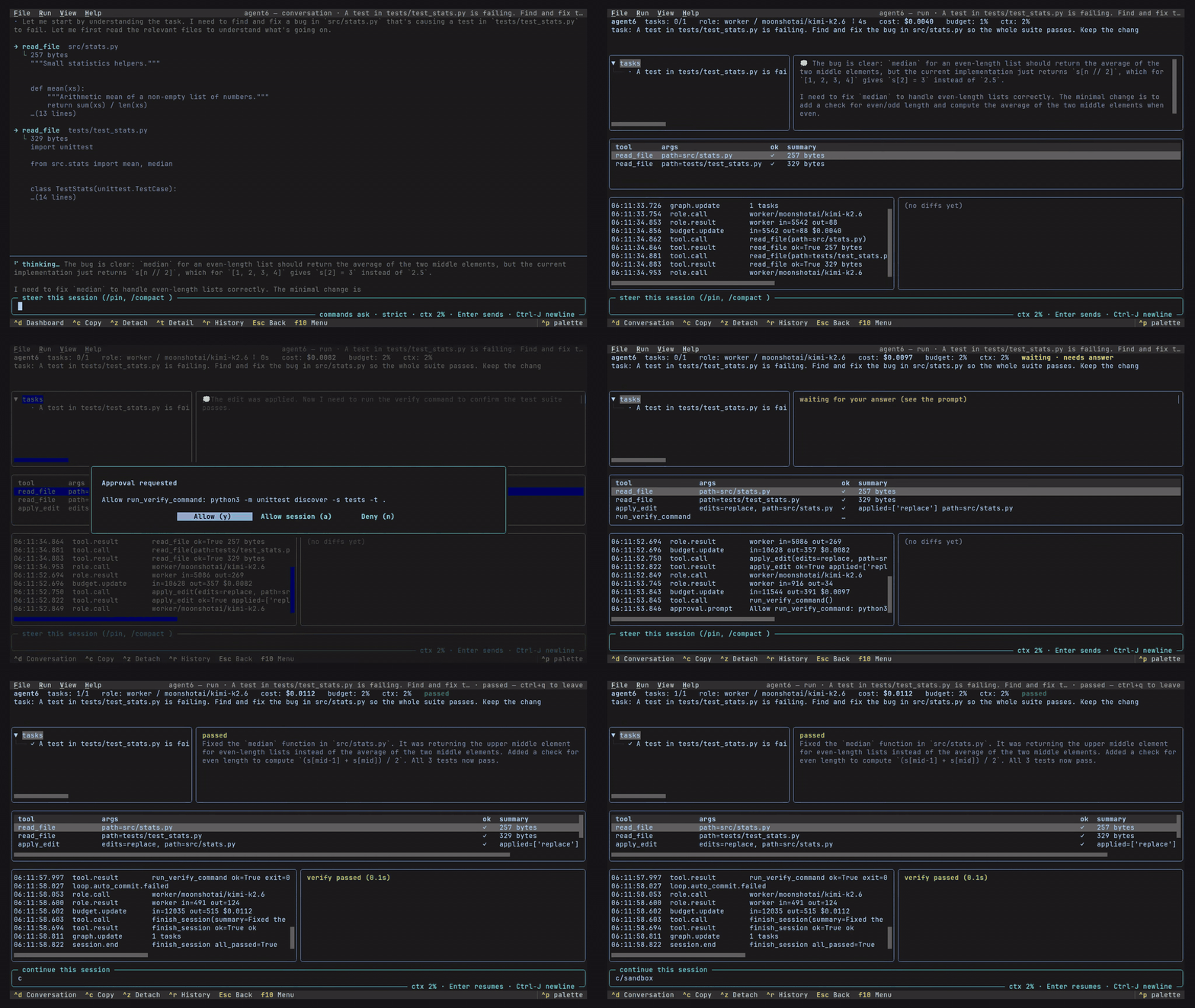
agent6 tui terminal interface |
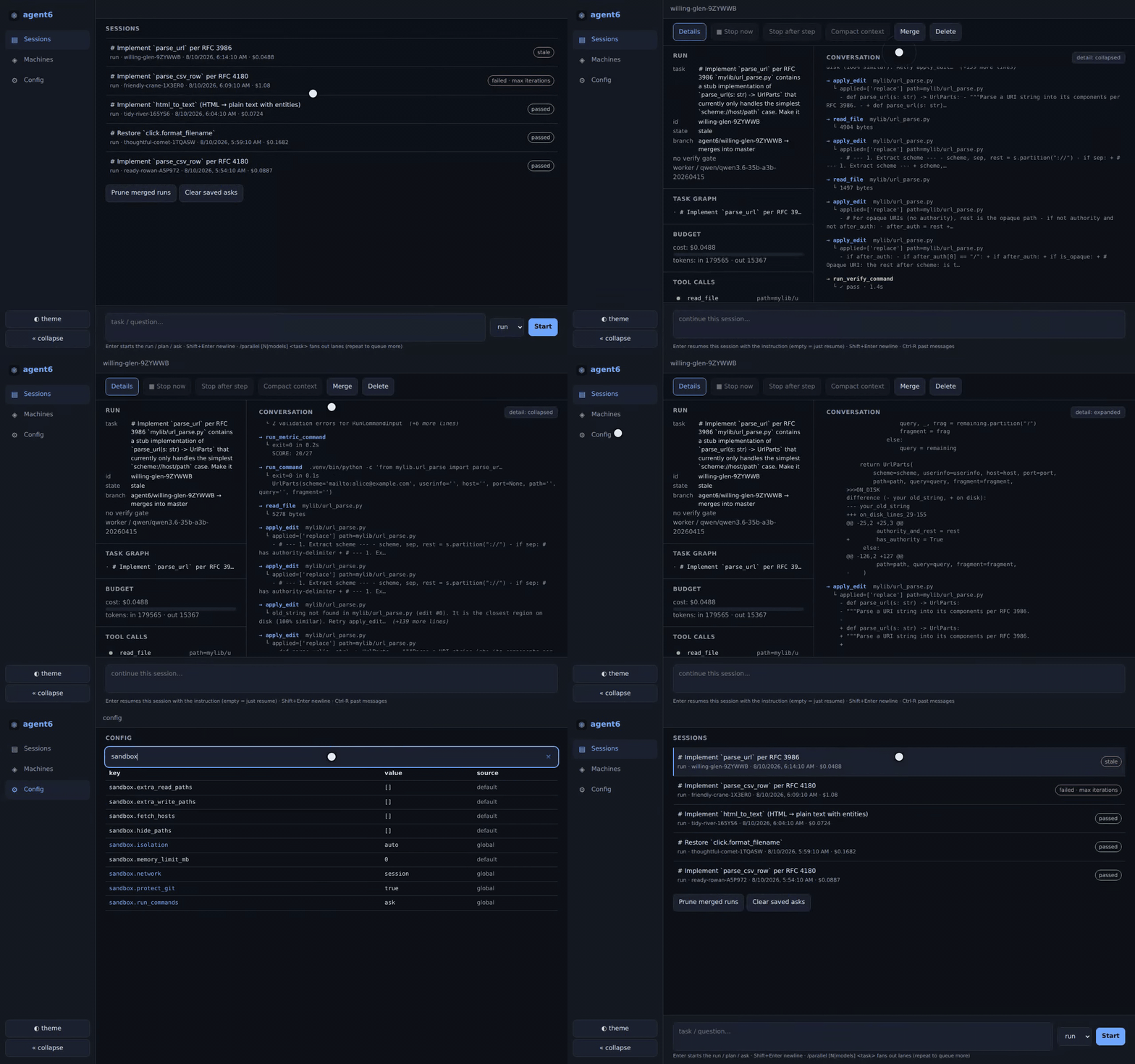
agent6 web browser interface for desktop or phone |
Also available as a streaming CLI and through ACP editor integration.
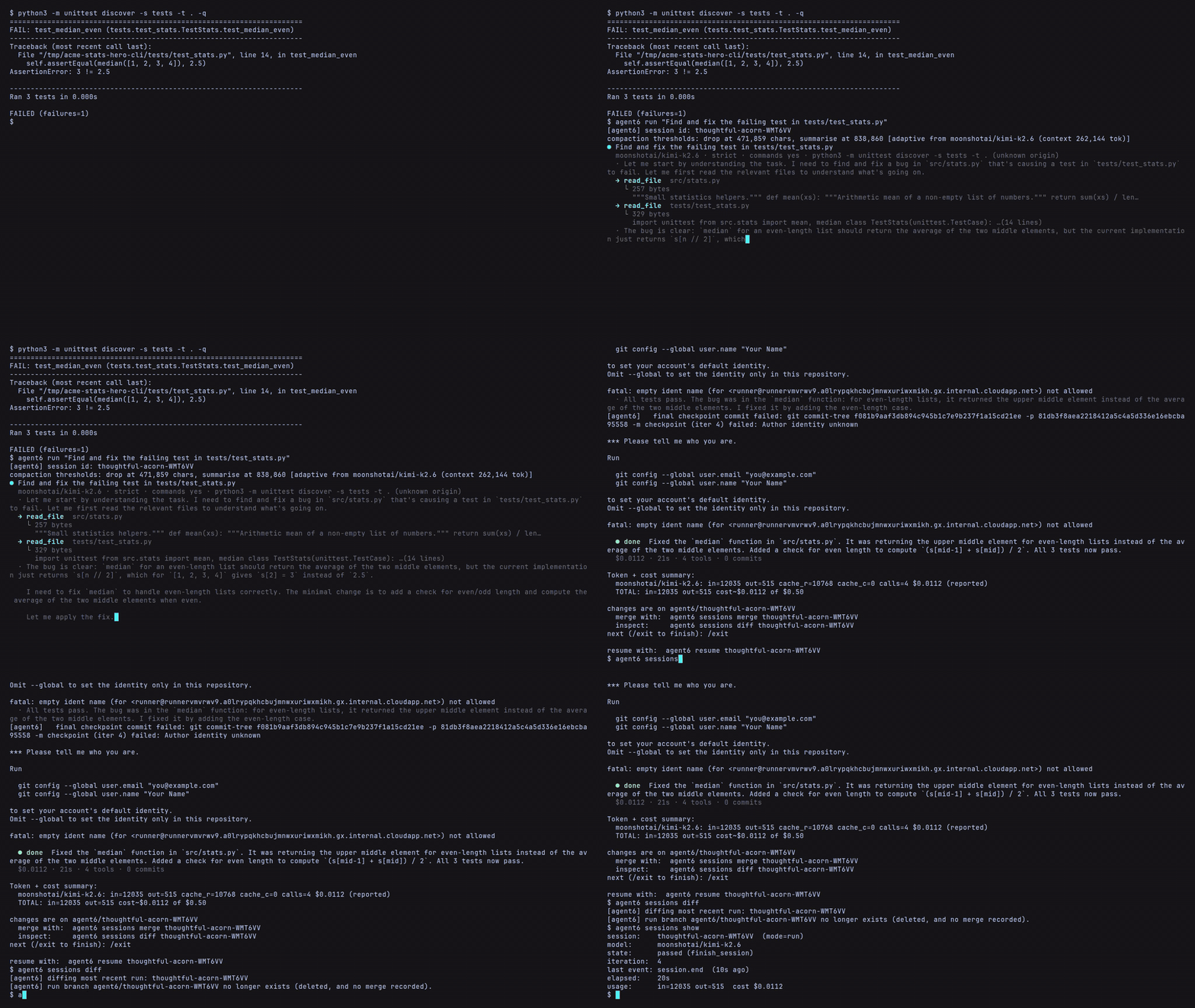
Sandboxing supports Linux on x86_64 and aarch64; macOS runs without it, and Windows users should use WSL.
Install with uv or pipx, then connect a provider and select a model:
uv tool install agent6      # or pipx install agent6
agent6 connect              # configure a provider
agent6 model worker         # choose a model
Use Anthropic or any OpenAI-compatible endpoint, including OpenAI, OpenRouter, Ollama, vLLM, llama.cpp, and LM Studio.
A provider entry can also use the Responses API (providers.<name>.backend = "responses") or sign in at a configured OAuth issuer.
For subscriptions, replace agent6 connect with agent6 connect chatgpt or agent6 connect claude; the latter uses your installed, signed-in Claude Code binary.
agent6 completions installs tab completion for your shell.
A run edits your current checkout.
Checkpoint commits go on a separate agent6/<id> branch; checkpointing leaves your current branch's history and index in place.
For a separate checkout, use agent6 run --worktree "your task", which starts from committed HEAD without copying uncommitted changes or untracked dependencies.
cd your-repo
agent6 check                # check configuration and sandbox support
agent6 run "your task here"
Commands ask for approval by default.
After the task finishes, enter another instruction or type /exit.
Inspect the latest session, then merge its recorded changes when ready:
agent6 sessions show        # status and verification result
agent6 sessions diff        # recorded changes
agent6 sessions merge       # merge into the run's starting branch
Other commands:
| Command | Purpose |
|---|---|
agent6 plan "task" |
plan a change; agent6 run --from <plan-id> carries it out |
agent6 ask "question" |
ask about the repository |
agent6 attach <id> |
follow a live session |
agent6 steer <id> "instruction" |
direct the next steps |
agent6 sessions findings <id> |
list a session's review findings |
agent6 sessions receipt <id> |
print the recorded tests, review outcome and how to revert |
agent6 stop <id> --after-turn |
stop after the current turn |
agent6 resume <id> |
continue an interrupted run |
agent6 fork <id> --at-turn 7 |
fork a coding run from an earlier turn into a separate worktree |
agent6 telemetry export |
export session journals as OpenTelemetry signals or a Prometheus textfile |
agent6 pack |
copy your config, secrets, sessions and memory into the workspace before a sync |
agent6 unpack |
move the packed files into the new home |
To give a finished run more work, use agent6 resume <id> --steer "next task".
agent6 config show prints effective settings and where each value came from.
Changes are global unless you add --repo for a repository override, for example:
agent6 config set --repo harness.verify_command '["uv", "run", "pytest"]'The worker, planner, and reviewer can use different models and reasoning effort; unset planner and reviewer roles use the worker. Budgets limit spending, tokens for unpriced calls, and supported subscription usage.
agent6 confines only the model's commands, in a jail on your host; the agent6 process stays trusted, holds your provider credentials, and connects to your configured providers.
The repository stays at its real path, and the jail sees your system toolchains and ~/.local/bin read-only.
sandbox.isolation = "auto" picks the strongest level the host allows and warns when it falls back:
full: commands cannot read your provider keys or the secrets file,.gitis read-only to them (sandbox.protect_git = "auto",git.control = "agent6"), and they get a private network (sandbox.network = "auto").partial: commands cannot read your keys or the secrets file, but they share agent6's network and can write.git.none: no confinement.
Commands ask for approval by default (sandbox.run_commands = "ask").
agent6's own git never pushes, rewrites history or runs reset --hard, and no config key turns that on.
MCP is off by default, and locally spawned servers use the command sandbox unless explicitly configured otherwise.
agent6 check sandbox shows the effective file and command boundaries, network and approval settings, and live probe results.
- Docker gives
partialby default and allowsfullwith both--security-opt seccomp=unconfinedand--security-opt apparmor=unconfined. - Rootless Podman allows
fullwith no flags (rootful Podman).
On Ubuntu, full under Docker also needs the host to allow the jail launcher to use unprivileged user namespaces (Installation).